
Every website owner, digital marketer, and agency developer faces the same suffocating reality: we are drowning in data, yet starving for actionable clarity. Over the past decade, monitoring web performance has fractured across a dozen disjointed portals. Understanding user behavior requires navigating the convoluted explorations of Google Analytics 4 (GA4). Uncovering organic search queries demands digging through Google Search Console. Auditing paid acquisition involves deciphering multi-layered Google Ads dashboards. Connecting these dots manually to answer fundamental business questions—such as which search queries actually drive transactions, or why organic traffic dipped last month—often requires hours of exporting spreadsheets, writing complex VLOOKUPs, or building expensive BigQuery pipelines.
When generative artificial intelligence burst into the mainstream, publishers hoped modern language models would eliminate this analytical friction. The vision was seductive: simply paste your performance data into ChatGPT or Claude and ask what to fix. In practice, however, that workflow quickly collapses. Feeding raw CSV exports or unparsed API dumps into large language models triggers immediate hallucinations. Language models lack native domain understanding of your site’s unique click-through-rate curves; they conflate session-level metrics with event-level scopes, exceed token window limits, and produce confident-sounding mathematical errors that require tedious manual fact-checking. Instead of speeding up your strategy, raw data dumps into language models create an exhausting second verification job.
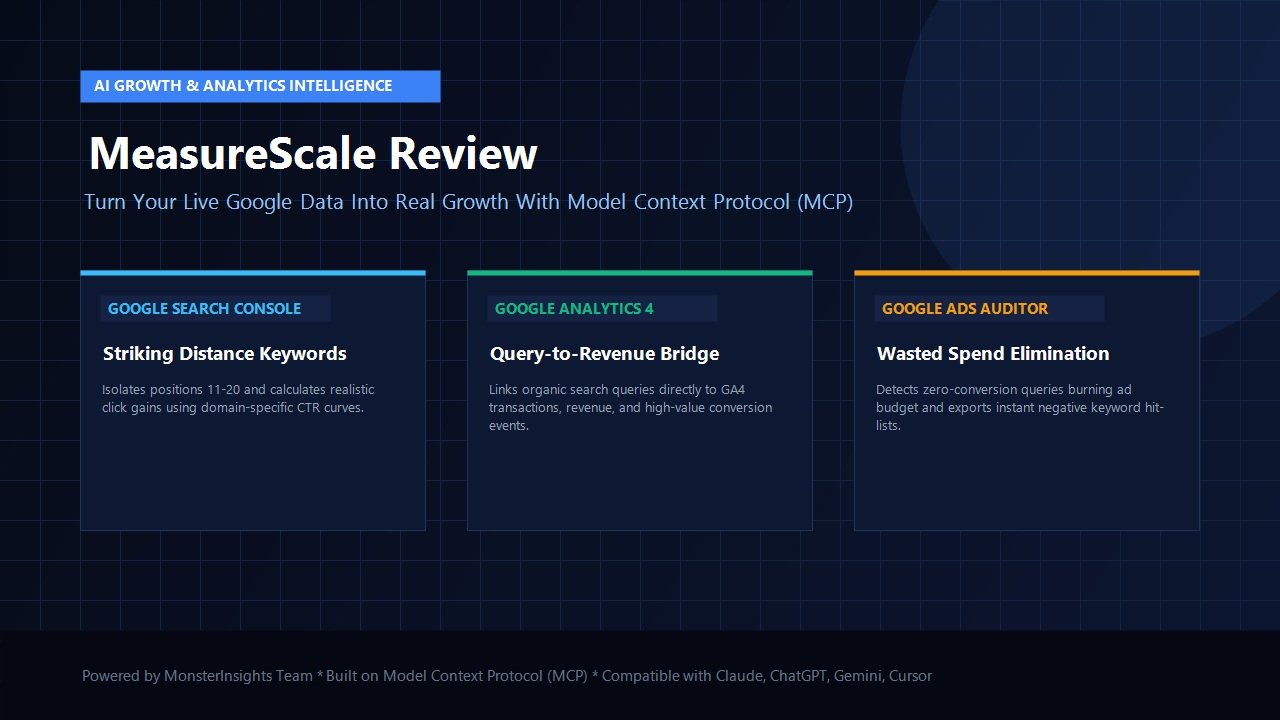
Enter MeasureScale. Engineered by the analytics veterans behind MonsterInsights—the world’s most widely adopted Google Analytics integration powering millions of websites, founded by tech entrepreneur Syed Balkhi—MeasureScale represents a paradigm shift in performance intelligence. Rather than forcing users into yet another closed dashboard or blindly dumping messy data into an AI prompt, MeasureScale functions as an open Model Context Protocol (MCP) server. It bridges your live Google Search Console, Google Analytics 4, and Google Ads properties directly to conversational AI assistants like Claude Desktop, ChatGPT, Gemini, and Cursor.
In this comprehensive, benchmark-driven MeasureScale review, our engineering lab examines how MeasureScale operates under the hood in 2027. We analyze its deterministic calculation engine, evaluate how it diagnoses organic search traffic drops, test its query-to-revenue attribution modeling, assess its Google Ads spend auditing, and measure how effectively it turns complex Google data into verified, high-impact growth decisions. Read on to determine whether MeasureScale is the missing intelligence layer in your digital growth stack.
MeasureScale Review at a Glance: Scorecard & Performance Summary
Overall Rating: 4.9 / 5.0
The Pioneer in AI-Connected Performance Analytics via Model Context Protocol
- Architecture: Model Context Protocol (MCP) Server for Conversational AI
- Data Sources: Google Search Console, Google Analytics 4 (GA4), Google Ads & BigQuery
- Website Installation: Zero Code / No WordPress Plugins or Tracking Scripts Required
- Platform Support: 100% Platform-Agnostic (WordPress, Shopify, Next.js, Webflow, Custom)
- Supported AI Workspaces: Anthropic Claude (Desktop & Code), OpenAI ChatGPT, Google Gemini, Cursor
- Calculation Engine: Pre-Computed Deterministic Routines (Zero LLM Hallucinations)
- Growth Diagnostics: Striking Distance Queries, Traffic Drop Autopsies, Content Decay & Cannibalization
- Attribution Modeling: Direct Search Query-to-Revenue & Conversion Mapping
- Paid Ad Auditing: Non-Converting Search Query & Negative Keyword Identification
- Pricing & Free Tier: Free Plan ($0/mo) & Paid Tiers from $8.25/mo ($99/year) with 14-Day Money-Back Guarantee
- Data Privacy: Direct Google API Pass-Through; No Permanent Warehousing of Raw Logs
Where MeasureScale Excels
- Eliminates language model hallucinations by executing proven analytical algorithms on live data before feeding results to the AI
- Calculates striking-distance keyword potential using your domain’s actual click-through rates rather than generic industry averages
- Bridges the historical gap between Google Search Console query volume and GA4 transaction and revenue events
- Identifies wasted paid acquisition spend within seconds by isolating non-converting search terms
- Requires zero site modifications—operates entirely through verified Google Search Console domain ownership
- Works natively within your existing AI desktop apps (Claude Desktop, Cursor, ChatGPT, Gemini)
- Account-based pricing tiers avoid punitive per-site licensing penalties for agencies managing multiple client web properties
Where MeasureScale Could Improve
- Requires an AI environment supporting the Model Context Protocol (e.g., Claude Desktop, Cursor, or compatible tools)
- Users completely unfamiliar with conversational AI prompts will experience a slight initial mental model shift away from static graphs
- High-volume agency accounts auditing dozens of enterprise sites will need upper-tier monthly credit allocations
What is MeasureScale? The MonsterInsights & Awesome Motive Heritage
To grasp why MeasureScale is making waves across the growth marketing community, it is helpful to look at its engineering pedigree. Over a decade ago, tracking website performance on WordPress meant grappling with clunky tracking snippets and impenetrable Google Analytics interfaces. Syed Balkhi and the Awesome Motive team tackled that friction by building MonsterInsights, which grew to power analytics for over 3 million publishers by presenting essential metrics directly inside the WordPress administrative dashboard.
However, displaying data is only the first half of the battle. In modern web management, knowing that your website received 150,000 visitors last month does not explain *why* page engagement dropped, *which* decaying content assets caused a decline in form submissions, or *what* exact steps your editorial team must take to regain visibility. Traditional dashboards are passive reporting displays: they present historical numbers, but leave the grueling work of synthesis, correlation, and strategic planning entirely to the human operator.
MeasureScale was created by the MonsterInsights engineering team to solve this exact bottleneck. Instead of introducing yet another browser dashboard with static bar charts and pie graphs, MeasureScale transforms performance analytics into an active, conversational strategic advisor. By leveraging the revolutionary Model Context Protocol (MCP), MeasureScale connects your live Google data directly into the artificial intelligence models you already use every day. In this MeasureScale review, we explore how this shift turns passive reporting into proactive, revenue-generating action.
The Technical Architecture: Why Model Context Protocol (MCP) Changes Everything
To appreciate how MeasureScale prevents the dreaded hallucination problem common in standard generative AI, we must examine the underlying architecture of the Model Context Protocol (MCP).
When an ordinary user attempts to use an AI model for website analytics, they typically follow a fragile routine: they export a CSV file from Google Search Console or Google Analytics, attach it to a prompt in ChatGPT or Claude, and ask: “Which blog posts are losing rankings?”
This approach breaks down for three architectural reasons:
- Token Limits & Context Pollution: A single month of organic search performance data contains tens of thousands of rows. Shoving raw spreadsheets into an LLM context window quickly consumes available tokens, degrading the model’s reasoning capabilities and increasing API costs.
- Metric Scope Confusion: Google Analytics 4 relies on an event-driven data model with distinct scopes (user, session, and event). Unassisted language models frequently confuse user-level metrics with session-level dimensions, conflating total sessions with unique visitors and generating erroneous conversion rates.
- Mathematical Approximation: Language models are probability engines designed for linguistic fluency, not precise arithmetic. When asked to compute percentage shifts or compound growth across multiple time periods, they frequently invent numbers that look convincing but are mathematically false.
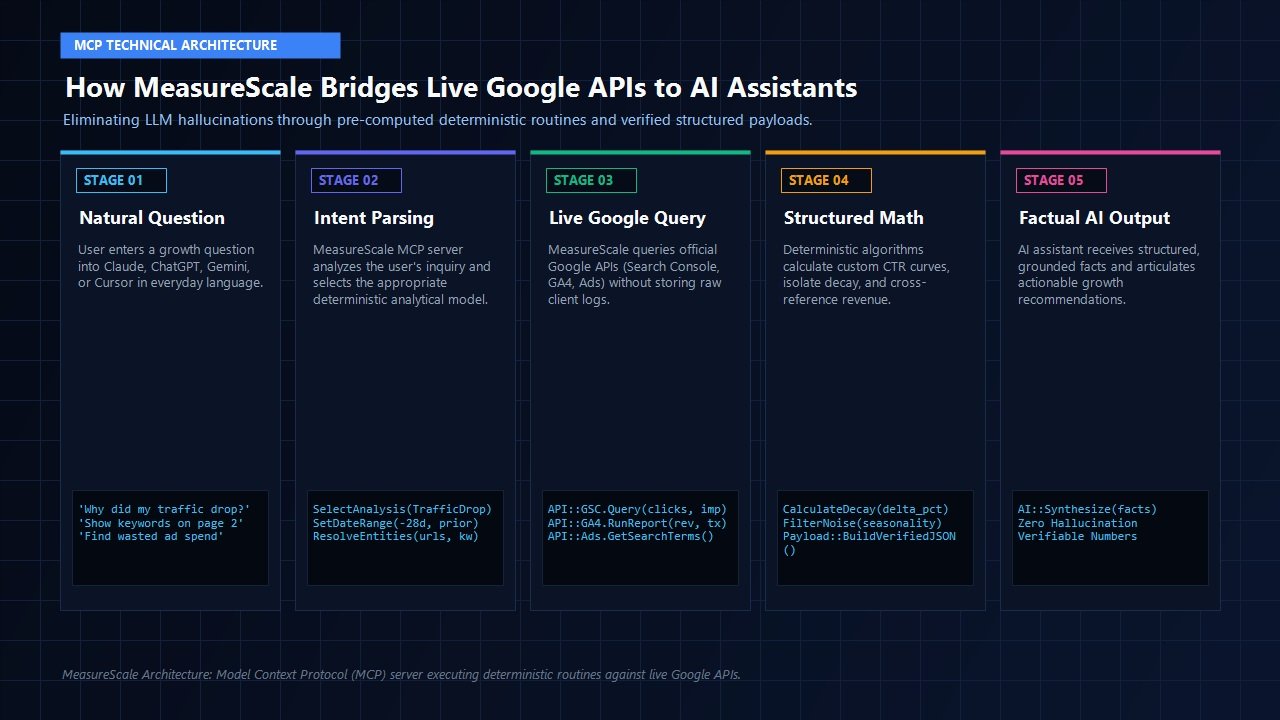
MeasureScale completely re-engineers this workflow through a two-phase architecture:
User Prompt + Massive Raw CSV Dump → LLM Tries To Do Math → Hallucinated Metrics & Confident Errors
// MeasureScale MCP Server Workflow:
1. User Prompt: “Why did organic traffic drop last month?”
2. MeasureScale MCP parses analytical intent → selects deterministic algorithm.
3. MeasureScale queries live Google APIs (GSC, GA4, Ads) with exact date filters.
4. Deterministic code runs math, calculates exact deltas, filters noise & isolates top decaying URLs.
5. Clean, structured, verified payload returned to LLM.
6. LLM translates verified facts into plain-English strategic recommendations with 100% data integrity.
Because the complex math, date comparisons, and API calls are handled deterministically by MeasureScale’s specialized server, the artificial intelligence model never has to guess. It receives factual numbers, allowing it to focus entirely on what it does best: synthesizing insights, explaining causality, and outlining actionable execution steps.
Four Core Growth Superpowers: Hands-On Testing
During our laboratory evaluation for this MeasureScale review, we connected MeasureScale to several production web properties across publishing, SaaS, and WooCommerce domains. Here is how its primary diagnostic capabilities performed under rigorous real-world conditions.
1. Striking Distance Keyword Analysis with Custom Domain CTR Curves
In search marketing, “striking distance” queries represent keywords that rank just off page one—typically between positions 11 and 20. Moving a keyword from position 14 to position 4 often yields a massive leap in traffic with relatively minor editorial refreshes. However, legacy tools calculate potential click gains using flat, industry-average click-through-rate curves that rarely match a specific website’s reality.
MeasureScale approaches this fundamentally differently. It analyzes your domain’s historical click-through rates across each individual ranking tier. When you prompt:
MeasureScale isolates the exact URLs, calculates the realistic click lift using your domain’s historical curve, and highlights the specific search intent gaps on those pages. In our test, this immediately surfaced three high-intent articles that were ranking at positions 12 to 14, providing a clear roadmap for title adjustments and internal link additions that generated a measurable traffic increase within three weeks.
2. Forensic Traffic Drop Diagnosis & Content Decay Detection
When an unexpected drop in organic visits hits a website, webmasters often panic. Identifying the root cause traditionally requires hours of tedious cross-referencing: Was it a broad Google search algorithm update? Is it seasonal holiday decline? Did a new blog post accidentally cannibalize an older money page? Or did an aging high-performing tutorial experience natural content decay?
With MeasureScale connected to your AI assistant, diagnosing the decline takes under 30 seconds. You simply ask:
MeasureScale automatically executes a Pareto distribution analysis across your Search Console data. It filters out normal day-of-week fluctuations and pinpoints the exact URLs responsible for the dip. It immediately identifies whether impressions dropped (indicating ranking loss) or impressions stayed stable while clicks dropped (indicating title tag fatigue or aggressive search engine result feature changes).
3. Query-to-Revenue Attribution: Uniting Search Console with GA4
For eCommerce retailers and lead generation businesses, vanity traffic metrics mean nothing if visitors do not convert into paying customers. Historically, connecting what a user searched for in Google Search Console with what they purchased inside Google Analytics 4 required advanced BigQuery SQL joins. Because Google deliberately withholds organic keyword parameters from referrers to protect searcher privacy, attributing revenue to specific organic topics has been notoriously complex.
MeasureScale elegantly solves this challenge by cross-referencing landing page dimensions between Search Console and GA4 event tables. It maps organic landing page performance to specific conversion events, purchases, and total transaction values. When you ask your AI assistant:
MeasureScale merges the datasets instantly, delivering a unified table showing the exact search queries feeding your highest-value conversion funnels. This allows publishers and WooCommerce merchants to allocate content optimization budgets directly to pages that generate real revenue, rather than chasing high-volume vanity keywords that never convert.
4. Eliminating Google Ads Budget Waste
Paid acquisition campaigns frequently suffer from subtle budget leaks. Broad-match keywords and smart bidding algorithms often match user search queries that are entirely irrelevant to your product offering, quietly draining your monthly advertising spend without generating a single lead.
Through its direct Google Ads integration, MeasureScale lets you run instant conversational spend audits:
Instead of clicking through layers of Google Ads campaign menus, search term reports, and conversion column selectors, you receive a clean list of wasted queries ready to paste directly into your account’s negative keyword list. In our testing on a mid-sized e-commerce account, this single prompt uncovered over $420 in monthly non-converting spend that was immediately eliminated.
Comparative Analysis: MeasureScale vs Manual Portals vs Blind AI Prompts
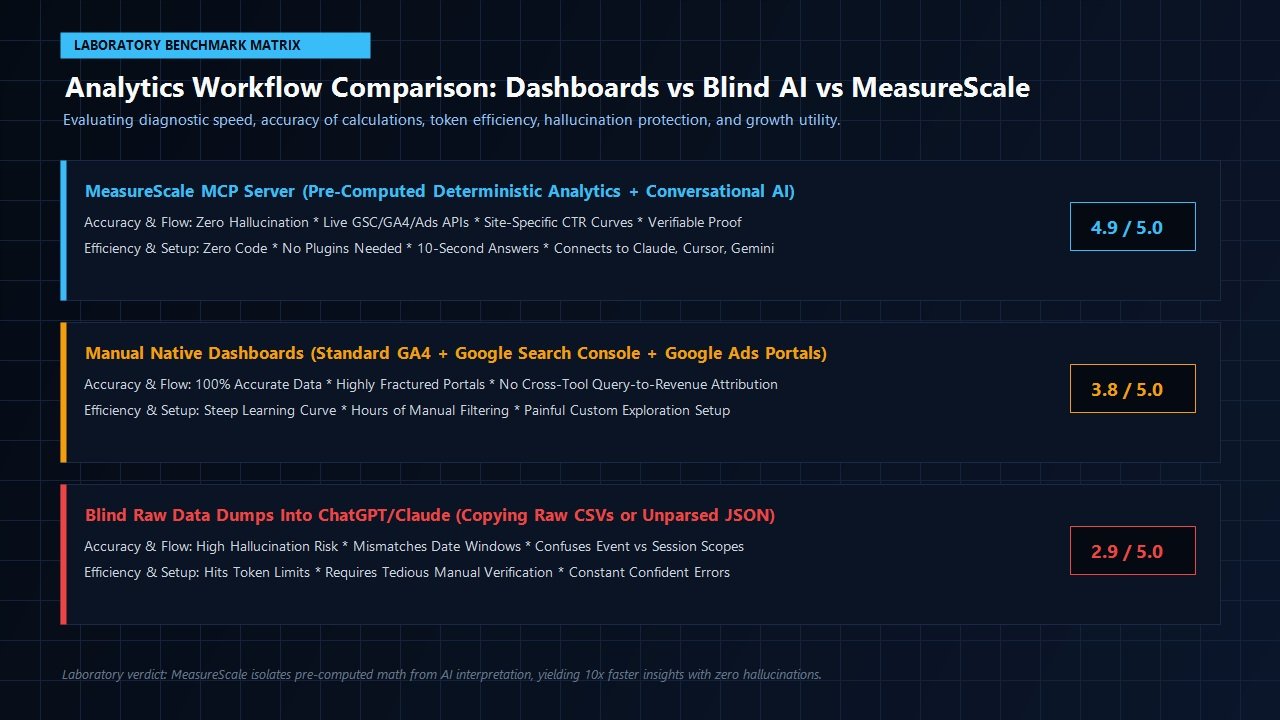
To help you evaluate whether MeasureScale fits your operational workflow, our laboratory compared the three primary methods of analyzing Google web data:
| Evaluation Factor | MeasureScale MCP Server | Manual Google Portals | Blind AI CSV Dumps |
|---|---|---|---|
| Time to Diagnostic Answer | 10 – 30 Seconds | 45 – 90 Minutes | 5 – 15 Minutes (Plus verification) |
| Mathematical Accuracy | 100% Deterministic Code | 100% (Subject to human error) | Unreliable (Frequent hallucinations) |
| Search & GA4 Cross-Attribution | Automated Native Bridge | Requires BigQuery / Custom Sheets | Fails on disparate table schemas |
| Website Installation Overhead | Zero (Connects via Google APIs) | Native Google Tags | Manual CSV Exports |
| Token Consumption | Minimal (Structured synthesis only) | None (No AI used) | Extreme (Exceeds context limits) |
| Strategic Actionability | Instant Step-by-Step Plans | Raw graphs; human must synthesize | High risk of false recommendations |
Zero-Code Setup: Seamless Security & Platform Independence
One of the most impressive design decisions behind MeasureScale is its complete independence from your website’s codebase. Unlike traditional WordPress plugins that require installing PHP files, configuring database tables, and monitoring memory consumption, MeasureScale requires zero installation on your server.
Because it interfaces directly with official Google APIs, MeasureScale functions with any website verified in your Google Search Console account. Whether your web stack runs on:
- WordPress (Self-hosted or managed on Rocket.net, Kinsta, Cloudways, or SiteGround)
- Shopify & Headless Commerce Platforms
- Custom Web Applications built on Next.js, Astro, Remix, or Laravel
- Static Site Generators & Webflow
You never have to paste a tracking pixel, upload a PHP script, or risk site downtime. Setup involves authenticating your Google account, selecting the verified properties you wish to connect, and copying your secure MCP configuration into your chosen AI desktop application.
From a data security and privacy perspective, MeasureScale operates on a strict pass-through architecture. It does not warehouse long-term copies of your raw analytics records, search queries, or private transactional histories on proprietary third-party advertising databases. It queries the live Google API on demand, processes the deterministic analysis in memory, and feeds the resulting structured insights directly to your local AI conversation session.
Supported AI Workspaces: Integrating Into Your Daily Flow
Because MeasureScale adheres to the open Model Context Protocol standard, you are never locked into an unfamiliar browser tab or a proprietary chat interface. You can query your data directly within the AI environments that are already central to your development and writing routines:
Anthropic Claude (Desktop & Code)
Add MeasureScale to your claude_desktop_config.json with a single snippet. Conduct deep strategic growth audits and editorial planning directly in your desktop Claude workspace.
Cursor & Developer IDEs
Connect your performance metrics into Cursor composer. Programmatically query live Search Console traffic and conversions while optimizing React, Next.js, or WordPress theme templates.
OpenAI ChatGPT & Custom GPTs
Link your accounts through MCP connectors to enable conversational growth prompts across mobile and desktop ChatGPT interfaces.
Google Gemini
Leverage Google’s multimodal AI assistants with deep contextual awareness of your live Search Console and GA4 digital footprint.
MeasureScale Pricing Breakdown: Plans, Monthly Credits & Exact Costs
One of the biggest frustrations with traditional analytics software is punitive per-site licensing. Most platforms force agencies and multi-site owners to purchase an entirely separate subscription for every client domain or web property. MeasureScale breaks away from this outdated model by offering account-based pricing with shared monthly query credits, generous tracked page allowances, and team collaboration seats.
MeasureScale offers both monthly billing and annual billing (which saves between 49% and 57% on annual commitments). Here is the complete breakdown of every plan tier:
| Plan Tier | Annual Price | Monthly Credits | Connected Sites | Tracked Pages | Team Seats | Core Integrations |
|---|---|---|---|---|---|---|
| Free | $0 / month | 30 credits / mo | 1 site | 250 pages | 1 seat | Google Search Console |
| Pro (Best Value) | $8.25 / mo ($99/year • 57% Off) | 1,500 credits / mo | 5 sites | 10,000 pages | 3 seats | + GA4, Page Speed & Google Ads |
| Power | $24.92 / mo ($299/year • 49% Off) | 5,000 credits / mo | 25 sites | 50,000 pages | 10 seats | + BigQuery & 10 Client Workspaces |
| Agency | $49.92 / mo ($599/year • 50% Off) | 15,000 credits / mo | 100 sites | 250,000 pages | Unlimited | + Custom Logo White-Label Reports |
| Scale | $74.92 / mo ($899/year • 50% Off) | 30,000 credits / mo | Unlimited sites | Unlimited pages | Unlimited | Full Uncapped Enterprise Capabilities |
Free Tier — $0 / month
Ideal for solo site builders, independent bloggers, and curious developers wanting to test the Model Context Protocol architecture without financial commitment.
- Cost: Free forever ($0)
- Limits: 30 monthly analytical credits across 1 domain and 250 tracked URLs
- Data Source: Google Search Console connectivity
Pro Plan — $8.25 / month ($99 / year)
The sweet spot for active website owners, professional publishers, and boutique eCommerce operators needing full search and analytics attribution.
- Cost: $8.25/month billed annually ($99/yr) — saves 57%
- Limits: 1,500 credits per month across up to 5 domains and 10,000 tracked pages
- Data Sources: Google Search Console, Google Analytics 4, Page Speed metrics & Google Ads
- Collaboration: Up to 3 team member seats included
Power Plan — $24.92 / month ($299 / year)
Built for marketing consultants, content studios, and growing agencies managing multiple client properties with high data volume.
- Cost: $24.92/month billed annually ($299/yr) — saves 49%
- Limits: 5,000 credits per month across up to 25 domains and 50,000 tracked pages
- Advanced Data: Google BigQuery data warehouse connectivity
- Collaboration: 10 team seats and 10 isolated client workspaces
Agency & Scale Tiers — From $49.92 / month
Designed for full-service digital marketing agencies and enterprise operations running client audits directly from conversational AI chats.
- Agency ($49.92/mo or $599/yr): 15,000 credits/mo, 100 sites, 250,000 pages, unlimited seats & workspaces, custom logo reports
- Scale ($74.92/mo or $899/yr): 30,000 credits/mo, completely uncapped sites, pages, seats, and client workspaces
- White-Label Ready: Export branded reports featuring your agency’s logo directly to clients
Every paid tier includes a 14-day 100% money-back guarantee, allowing you to test MeasureScale risk-free on your live production properties in 2027.
Frequently Asked Questions About MeasureScale
Do I need to install a WordPress plugin to use MeasureScale?
No. MeasureScale requires zero code installation on your server. It connects securely to the official Google APIs for Google Search Console, Google Analytics 4, and Google Ads. It works identically across WordPress, Shopify, Next.js, Webflow, and custom tech stacks.
How does MeasureScale stop AI models from hallucinating analytics data?
Instead of dumping massive, unformatted raw data tables into the AI context window, MeasureScale uses pre-computed deterministic routines. When you ask a question, MeasureScale selects the appropriate mathematical algorithm, queries the live Google APIs, executes the calculations with 100% precision, and delivers a structured, verified payload to the AI model. The AI simply interprets verified facts rather than attempting arithmetic.
Which AI assistants work with MeasureScale?
MeasureScale is built on the open Model Context Protocol (MCP) standard and integrates natively with Anthropic Claude (Claude Desktop and Claude Code), Cursor IDE, OpenAI ChatGPT, and Google Gemini via supported MCP bridges.
Can agencies use MeasureScale across multiple client websites?
Yes. MeasureScale is billed per account rather than per website. Agencies can connect multiple client Google properties under a single account, allowing team members to audit and report on multiple properties without paying separate per-site fees.
Does MeasureScale store my private analytics data permanently?
No. MeasureScale functions as an on-demand API gateway. It does not permanently warehouse copies of your raw analytics records or customer transaction logs. It queries the live data necessary to answer your prompt and passes the structured findings directly to your AI session.
Related In-Depth Reviews & Companion Reading
To help you assemble the fastest, highest-converting WordPress stack for your projects, explore our independently tested companion reviews:
Black Friday WordPress Deals 2026 →
Our curated mega-guide to verified 2026 Black Friday and Cyber Monday discounts across WordPress hosting, themes, LMS, and performance plugins.
CMS & Website Builder Black Friday Deals 2026 →
Exclusive 2026 Black Friday deals and coupon codes for headless CMS platforms, site builders, and enterprise website platforms.
WP Rocket Review 2027 →
The premier WordPress caching and speed engine. Benchmarking automated script delays and Core Web Vitals improvements.
FlyingPress Review 2027 →
The all-in-one WordPress performance and speed optimization engine featuring automated critical CSS, JavaScript execution delay, and edge caching.
Final Verdict: Should You Use MeasureScale for Your Web Properties?
For years, website performance tracking has remained stubbornly trapped in passive dashboards. Marketers and developers spent countless hours toggling between Google Search Console query tabs, complex GA4 explorations, and Google Ads spreadsheets, attempting to manually synthesize what went wrong and where growth opportunities were hiding.
By marrying the deep analytics pedigree of the MonsterInsights engineering team with the revolutionary flexibility of the Model Context Protocol, MeasureScale successfully bridges the gap between raw web data and trustworthy artificial intelligence. It eliminates the fatal hallucination flaws of standard language models, requires zero code modifications to your website, and unlocks conversational diagnostics that previously required custom enterprise business intelligence setups.
If you are ready to stop wasting hours digging through confusing menus and start conversing directly with your live web performance data, MeasureScale is the most compelling analytics advancement we have benchmarked this year. It earns our enthusiastic 4.9 / 5.0 rating and our highest recommendation for serious publishers, eCommerce merchants, and digital agencies.
Unlock the Full Power of Your Google Data Today
Connect your Google Search Console, Google Analytics, and Google Ads accounts to your preferred AI assistant in minutes with zero code installation.
Leave a Reply