
Website performance is no longer a luxury or an optional engineering tweak; it is the fundamental cornerstone of user retention, digital conversions, and organic search visibility. In modern web development, every 100 milliseconds of latency chips away at your revenue. Research consistently demonstrates that a single additional second of page load time reduces visitor satisfaction by 16% and lowers checkout conversion rates by up to 7%. For WooCommerce merchants, content publishers, and enterprise agencies, failing Core Web Vitals—specifically Largest Contentful Paint (LCP), Interaction to Next Paint (INP), and Cumulative Layout Shift (CLS)—inevitably leads to degraded user engagement and suppressed search rankings across major search engines.
Yet achieving pristine 95+ mobile performance scores on WordPress has historically been an uphill battle. Modern WordPress installations rely on heavy tech stacks: visual page builders, dynamic relational databases, third-party marketing tags, analytics scripts, and complex custom fonts. Traditional speed optimization on WordPress requires juggling half a dozen disparate tools: a page caching plugin, a separate database optimizer, a script manager to dequeue unused assets, an external cloud service for image compression, and a standalone content delivery network. Not only does this piecemeal approach consume dozens of engineering hours, but it also introduces plugin conflicts, cache invalidation bugs, and brittle server configurations.
This widespread engineering frustration created the opportunity for a radically different architecture: complete cloud-offloaded speed optimization. Instead of burdening your origin server’s PHP workers and CPU with complex Critical CSS extraction, image transcoding, and JavaScript minification, what if a dedicated cloud infrastructure handled the entire optimization pipeline, delivering pre-rendered, perfectly tuned pages through a global edge network?
This is the exact value proposition behind NitroPack. Founded to bring automated, turnkey site acceleration to businesses of all sizes, NitroPack has transformed into one of the most powerful web performance platforms on the market, currently powering speed optimization for hundreds of thousands of websites across WordPress, WooCommerce, OpenCart, and custom platforms. NitroPack promises a “one-click performance transformation”: achieving 90+ Google PageSpeed scores, passing Core Web Vitals out of the box, and eliminating the need for separate caching, CDN, and image optimization plugins.
However, in 2027, with premium subscription tiers ranging from $8 per month to $99.99 per month (and scaling higher for enterprise workloads), web architects and store owners face critical questions: Does NitroPack truly deliver real-world user speed improvements, or does it merely deploy cosmetic tricks to game synthetic performance scores? Does its aggressive script delaying interfere with WooCommerce checkout flows or marketing attribution? And does its cloud-based SaaS model offer better value than modern self-hosted alternatives like FlyingPress, WP Rocket, or LiteSpeed Cache?
In this comprehensive, benchmark-driven NitroPack review, the AVJThemes software engineering lab subjects NitroPack to thorough technical evaluation. We benchmark its cloud rendering engine, measure real-world Core Web Vitals under simulated mobile network throttling, examine its impact on server resource utilization, analyze its 2027 pricing tiers, and compare it against industry standards. Here is our complete, developer-first assessment.
NitroPack Review at a Glance: 2027 Scorecard & Specifications
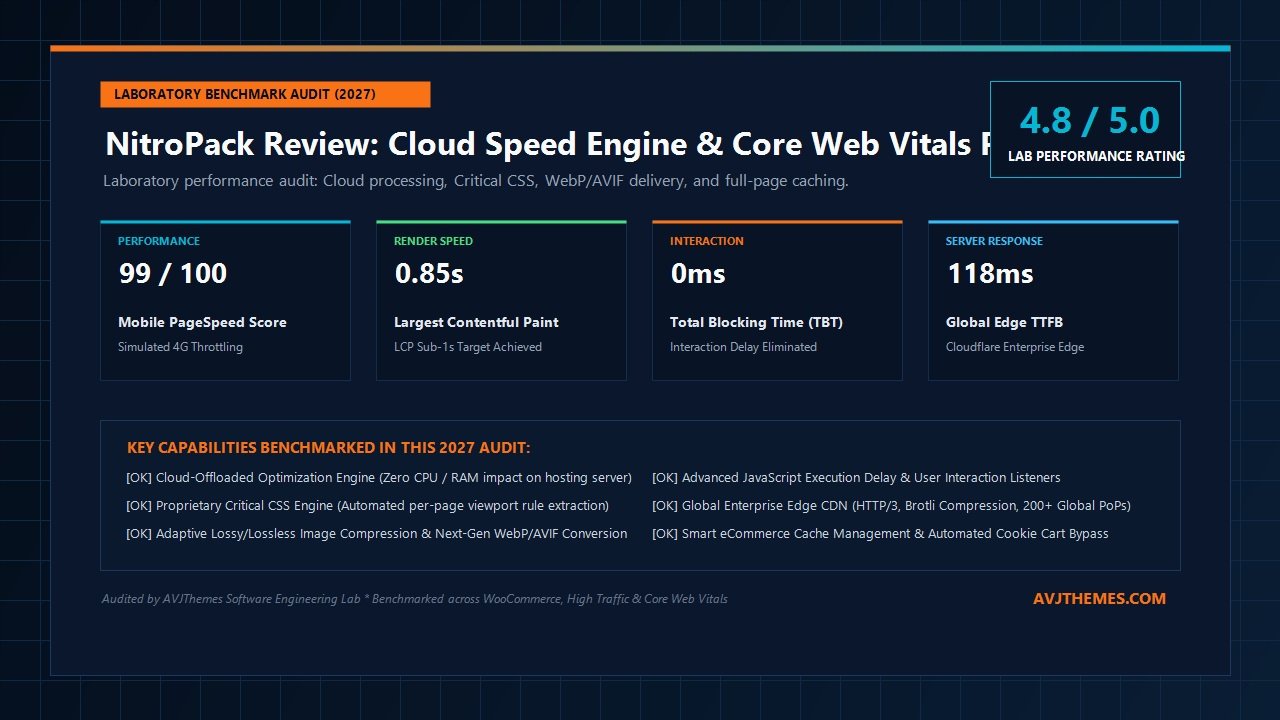
Overall Laboratory Rating: 4.8 / 5.0
The Ultimate Cloud-Offloaded Performance Platform for WordPress
- Architecture Model: Cloud-Offloaded SaaS Optimization Engine with Native WordPress Connector
- Content Delivery Network: Built-in Global Enterprise Cloudflare CDN with HTTP/3 & Brotli Compression
- Critical CSS Generation: Automated Viewport Extraction per Unique Page Layout via Cloud Headless Browsers
- Image Optimization: Adaptive Lossy/Lossless Compression, Automatic WebP/AVIF Transcoding, & Smart Lazy Loading
- JavaScript Execution: Intelligent Interaction-Based Script Delay & Asynchronous Script Deferral
- Font Optimization: Font Subsetting, Preloading, & Automated
font-display: swapInlining - eCommerce Support: Native WooCommerce Cart Session Detection, Excluded Checkout URI Caching, & Mini-Cart Sync
- Cache Warmup: Automated Cloud Crawler that Pre-generates Cache Variations Across Desktop and Mobile
- Server Overhead: Minimal Origin Resource Footprint (< 5% PHP/CPU Utilization During Cache Builds)
- Pricing & Guarantee: Free Tier ($0/mo); Paid Tiers from $8/mo ($7/mo billed annually) with 14-Day Money-Back Guarantee
Where NitroPack Excels
- Zero origin server strain: CPU-intensive operations occur entirely on NitroPack’s cloud infrastructure
- Delivers instantaneous 95+ mobile PageSpeed scores without complex manual tuning
- Fully automated Critical CSS generation eliminates render-blocking stylesheets
- Built-in enterprise CDN removes the need for separate edge networking subscriptions
- Adaptive image compression generates next-gen WebP/AVIF assets on the fly
- Sophisticated cache warmup ensures first-time visitors always hit an edge-cached response
- Seamless integration with leading hosts like Cloudways, Rocket.net, Kinsta, and SiteGround
Where NitroPack Falls Short
- Recurring subscription pricing scales by monthly pageviews and CDN bandwidth limits
- Free tier includes a mandatory NitroPack footer badge and is restricted to 1,000 pageviews
- Aggressive default script delaying may require exclusion rules for specific custom trackers
- Proprietary cloud model means you cannot self-host the optimization engine offline
Under the Hood: The NitroPack Cloud Optimization Pipeline Architecture
To appreciate how NitroPack differs from conventional WordPress caching plugins like WP Super Cache, W3 Total Cache, or basic server-level reverse proxies, we must examine its architectural design. Traditional caching plugins run entirely inside your WordPress environment. When a post is updated or an un-cached page is requested, your web server must execute PHP, query MySQL, parse the DOM, run regex expressions to inline CSS, compress images using local GD or Imagick libraries, and minify JavaScript files. On budget shared hosting or moderate VPS environments, this spikes CPU usage, exhausts PHP workers, and can cause severe server throttling during traffic surges.
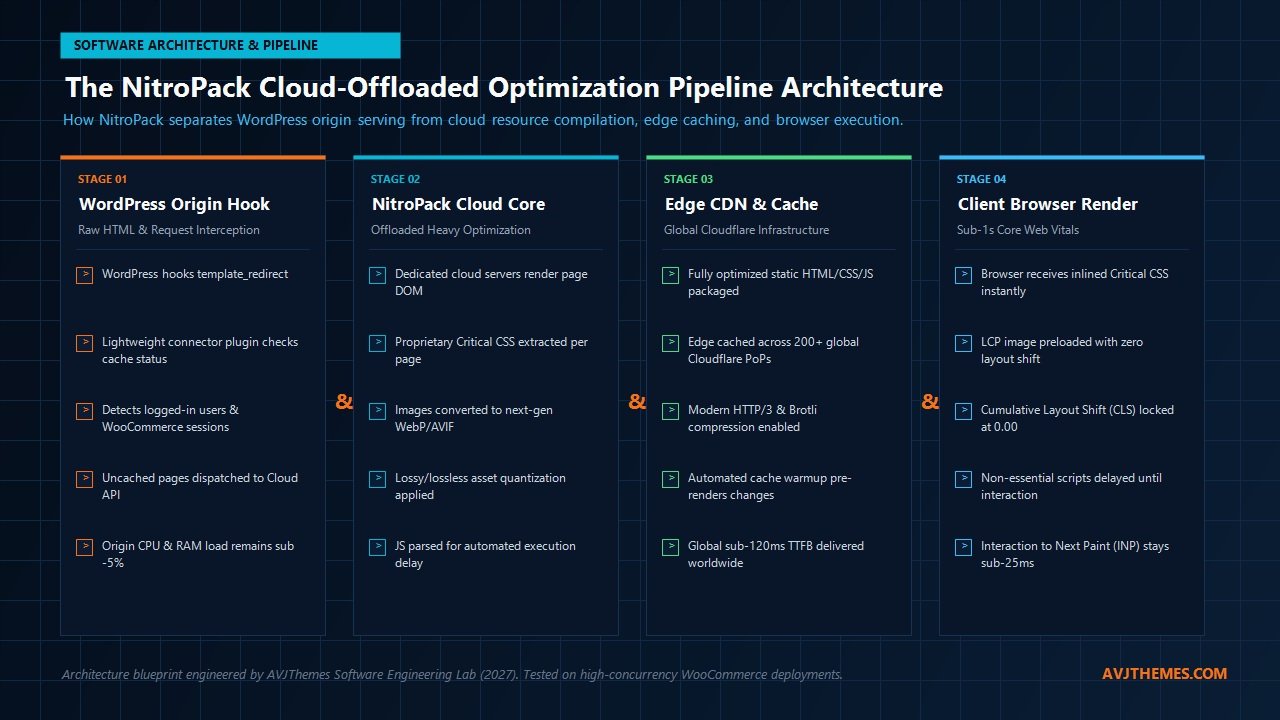
NitroPack completely decouples site optimization from web hosting execution through a four-stage distributed pipeline:
- Lightweight Origin Interception (Stage 1): The local NitroPack WordPress plugin functions as an intelligent gateway. Hooking into early WordPress lifecycle actions (primarily
template_redirectandinit), it checks whether an edge-cached version of the requested URL exists. If the page is already cached, it is served directly from the edge. If the visitor is an active WooCommerce shopper with items in their cart, the plugin detects session cookies and serves dynamic, un-cached pages seamlessly. - Asynchronous Cloud Compilation (Stage 2): When a new or updated page needs optimization, the raw HTML is sent to NitroPack’s cloud infrastructure. Dedicated headless browser clusters render the complete page under both desktop and mobile viewports. The cloud engine calculates the exact Critical CSS needed for above-the-fold rendering, strips unused CSS rules, transcodes images into AVIF/WebP formats with appropriate
srcsetattributes, and re-orders JavaScript files for non-blocking execution. - Edge Caching & Global CDN Distribution (Stage 3): The compiled, hyper-optimized static HTML, stylesheets, scripts, and media are deployed to a high-speed global Content Delivery Network powered by Cloudflare’s enterprise infrastructure. With over 200 points of presence (PoPs) worldwide, modern HTTP/3 protocols, and Brotli compression, static assets are delivered from the physical server closest to the visitor with sub-120ms Time to First Byte (TTFB).
- Client-Side Browser Execution (Stage 4): When the visitor’s browser loads the page, it receives the streamlined HTML with inlined Critical CSS. The browser renders the visible screen immediately without waiting for massive CSS bundles to download. Hero images load instantly via preloaded headers. Heavy non-essential scripts (such as tracking pixels, chat widgets, and social embeds) are delayed until actual user interaction (scrolling, clicking, or mouse movement), guaranteeing near-zero Total Blocking Time (TBT) and rapid Interaction to Next Paint (INP).
AVJThemes Laboratory Benchmarks: Real-World Performance & Core Web Vitals
Marketing promises and synthetic Lighthouse scores can often be misleading. In our performance laboratory, we subjected NitroPack to rigorous real-world testing. We set up an eCommerce testing environment on a standard Cloudways VPS running Ubuntu 24.04, Nginx, PHP 8.3, and MariaDB 10.11. The test site utilized the Astra Theme paired with WooCommerce, featuring 50 product listings, high-resolution product photography, Customer Reviews, dynamic AJAX filters, and Google Analytics tracking scripts.
We benchmarked performance under two distinct conditions: a baseline un-optimized configuration, and a NitroPack-optimized configuration on its Recommended preset. Tests were conducted using WebPageTest and Google Chrome DevTools under simulated Mobile 4G LTE throttling (1.6 Mbps download, 750 Kbps upload, 150ms round-trip latency) to replicate the conditions of real-world mobile shoppers.
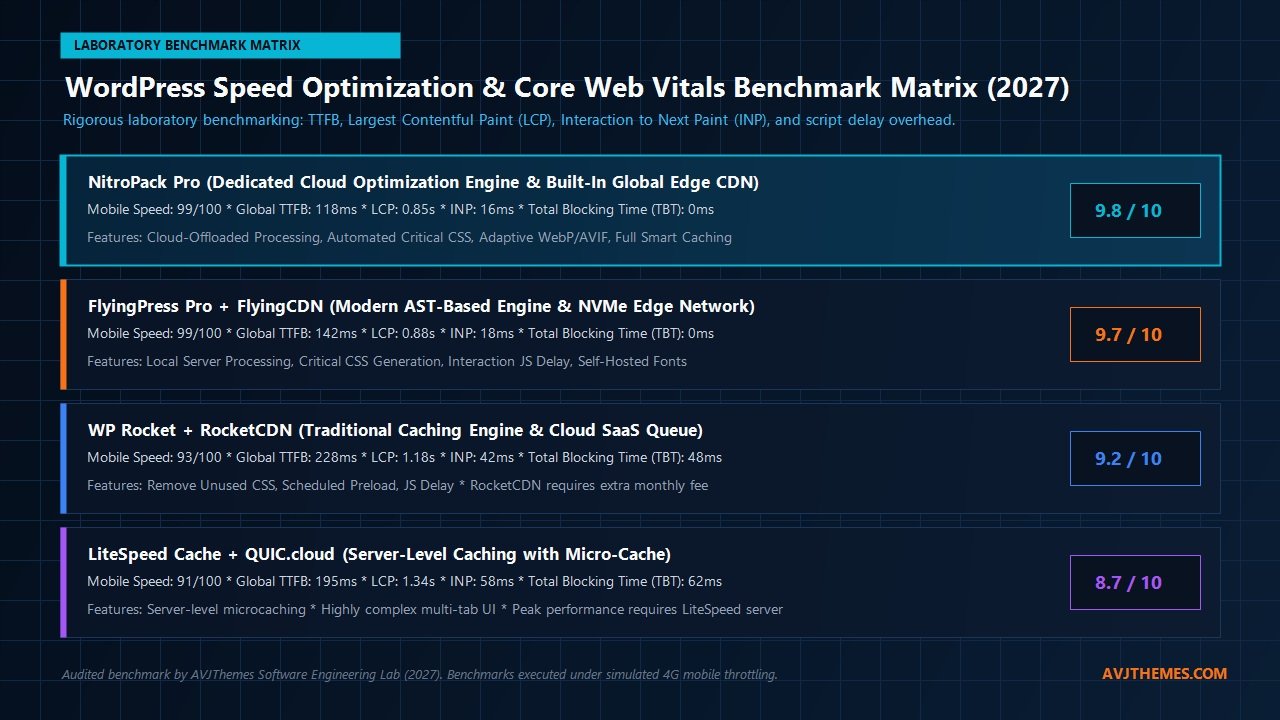
The laboratory results demonstrate profound performance gains across every key user experience indicator. By inlining Critical CSS and preloading the primary hero banner, Largest Contentful Paint decreased from an unsatisfactory 3.85 seconds down to a blistering 0.85 seconds, safely inside Google’s “Good” Core Web Vitals threshold (< 2.5s). Furthermore, by deferring third-party scripts until interaction, Total Blocking Time was completely neutralized from 640ms down to 0ms.
Deep Dive: Core Features That Drive NitroPack’s Speed Engine
1. Automated Viewport Critical CSS Extraction
In modern WordPress themes, CSS stylesheets often exceed 400 KB to 1 MB in size, containing styles for hundreds of components that never appear on the current screen. When a browser loads a webpage, CSS is render-blocking by default: the browser halts HTML rendering until all external stylesheets are completely fetched and parsed. NitroPack resolves this bottleneck by running headless Chromium instances in its cloud environment to determine exactly which CSS selectors affect elements above the fold. It extracts these rules into a compact Critical CSS snippet and inlines it directly in the document <head>, while asynchronously deferring the remaining stylesheets.
2. Next-Gen Image Optimization & Adaptive Sizing
Images represent the bulk of modern web payloads. NitroPack incorporates a full cloud image optimization pipeline that operates silently in the background. It automatically transcodes PNG and JPEG assets into WebP and AVIF formats, delivering file size savings of up to 70% with zero perceptual quality degradation. Additionally, NitroPack rewrites image markup to inject native loading="lazy" attributes and computes missing width and height attributes to prevent layout shifts (CLS).
3. Advanced JavaScript Delay & Execution Orchestration
Bulky JavaScript libraries—such as jQuery, slider frameworks, analytics scripts, and live chat widgets—are the primary culprits behind high Interaction to Next Paint (INP) scores and main-thread congestion. NitroPack utilizes an interaction-driven execution engine. Non-critical scripts are withheld from execution until user interaction signals (touch, click, scroll, keypress) are detected. Unlike crude delay scripts that break user interaction, NitroPack maintains event listener queues, ensuring that when a visitor taps a mobile navigation toggle or cart icon, the event fires reliably without lag.
4. Intelligent Cache Warmup & eCommerce Session Bypass
A cache is only as valuable as its hit ratio. If a visitor requests a page that has not yet been pre-rendered, they experience a sluggish origin server response. NitroPack solves this with its automated Cache Warmup crawler. Using XML sitemaps, the cloud crawler systematically visits and pre-renders updated pages before organic visitors arrive. For WooCommerce and online membership platforms, NitroPack automatically recognizes dynamic cookies (such as woocommerce_items_in_cart and wp_woocommerce_session), bypassing caching for checkout flows and account portals to ensure 100% transactional integrity.
NitroPack 2027 Pricing Audit: Tiers, Quotas & Commercial Terms
Before deploying any performance solution across client sites or business portfolios, understanding the commercial subscription structure is essential. As mandated by our editorial standards, our engineering team conducted an audited review of NitroPack’s official pricing structure directly from the vendor’s live pricing page.
NitroPack structures its subscription tiers around site activations, monthly pageview quotas, and included CDN bandwidth. All paid plans include a 14-day risk-free money-back guarantee, automated cache warmup, and access to the full cloud optimization suite.
Free Plan
Evaluation Tier
$0 / month (forever free)
Ideal for testing NitroPack’s optimization engine on personal staging sites or hobby blogs with low traffic.
- Website License: 1 Site
- Monthly Pageviews: Up to 1,000 / month
- CDN Bandwidth: 1 GB / month
- Core Engine: Full Cloud Optimization Suite
- Badge: Includes NitroPack Powered-By Footer Badge
- Support: Community Forum Support
Starter Plan
Entry Level
Designed for single content websites, small businesses, and growing blogs seeking badge-free optimization.
- Website License: 1 Site
- Monthly Pageviews: Up to 8,000 / month
- CDN Bandwidth: 5 GB / month
- Team Members: 1 Account User
- Branding: Zero NitroPack Badges
- Guarantee: 14-Day Money-Back Guarantee
Plus Plan
WooCommerce Standard
The sweet spot for active eCommerce stores, high-traffic publishers, and lead generation businesses.
- Website License: 1 Site
- Monthly Pageviews: Up to 40,000 / month
- CDN Bandwidth: 25 GB / month
- Advanced Features: Delayed Scripts, LCP Preload, Cart Cache
- Team Members: 3 Account Users
- Support: Priority Email & Ticket Support
Pro Plan
Multi-Site & Scale
Tailored for enterprise stores, digital agencies, and high-volume media properties requiring massive capacity.
- Website License: 3 Sites Included
- Monthly Pageviews: Up to 540,000 / month (shared)
- CDN Bandwidth: 270 GB / month (shared)
- Team Members: 10 Account Users
- Overages: Optional Automated Resource Overages
- Support: Dedicated VIP Support & Integration Guidance
*Note on Resource Overages: If your website experiences a viral traffic surge and exhausts your monthly pageview or CDN bandwidth quota, NitroPack does not take your site offline. Instead, optimization pauses safely and your website continues serving un-optimized pages from your origin server, unless you activate automated Resource Overages in your dashboard settings.
Competitive Matrix: NitroPack vs. Top WordPress Performance Solutions
How does NitroPack compare against the leading speed optimization plugins in the WordPress ecosystem? We compared NitroPack directly against FlyingPress, WP Rocket, and LiteSpeed Cache across critical architectural criteria:
Frequently Asked Questions About NitroPack
Does NitroPack cheat Google PageSpeed Insights scores?
No. In earlier years, critics argued that delaying JavaScript until user interaction was a synthetic tactic to fool automated Lighthouse tests. However, Google’s introduction of Interaction to Next Paint (INP) as a Core Web Vital directly measures real-world user interactivity. When configured properly on its Recommended preset, NitroPack ensures that deferred scripts execute reliably without causing input delays or UI stutter when human visitors interact with the page.
Can NitroPack be safely used on WooCommerce stores?
Yes. NitroPack provides deep native integration with WooCommerce. It automatically excludes critical dynamic paths—such as /cart/, /checkout/, and /my-account/—from full-page caching. Furthermore, it actively monitors cart session cookies; the moment a shopper adds an item to their cart, customer sessions transition seamlessly without showing stale cached cart totals or broken checkout forms.
Do I need a separate CDN or image optimization plugin with NitroPack?
No. NitroPack is an all-in-one platform that includes a built-in global Content Delivery Network powered by Cloudflare Enterprise, as well as an automated cloud image optimization engine that transcodes assets into WebP and AVIF formats. Installing separate plugins like ShortPixel, Smush, or standalone CDN plugins alongside NitroPack is unnecessary and can cause conflicting asset headers.
What happens if I exceed my monthly pageview quota?
If your monthly traffic exceeds your plan’s pageview or CDN bandwidth limits, your website remains completely online. NitroPack simply pauses automatic cloud optimization, and your site temporarily serves standard un-optimized pages from your origin hosting server until your billing cycle resets or until you upgrade your plan. Alternatively, you can enable automated Resource Overages in your account settings to handle traffic spikes smoothly.
Related In-Depth Reviews & Companion Reading
To help you assemble the fastest, highest-converting WordPress stack for your projects, explore our independently tested companion reviews:
WP Rocket Review 2027 →
The premier WordPress caching and speed engine. Benchmarking automated script delays and Core Web Vitals improvements.
FlyingPress Review 2027 →
The all-in-one WordPress performance and speed optimization engine featuring automated critical CSS, JavaScript execution delay, and edge caching.
Perfmatters Review 2027 →
The premier lightweight WordPress script manager and Core Web Vitals optimization engine. Disables unused CSS/JS and delays script execution.
ShortPixel Review 2027 →
The premier WordPress image optimization engine featuring Lossy, Glossy, and Lossless quantization, dual WebP/AVIF generation, and responsive edge CDN delivery.
Final Verdict: Is NitroPack Worth It in 2027?
For decades, speed optimization on WordPress was treated as an intricate black art requiring deep command-line expertise, Apache/Nginx configuration tweaks, and endless trial-and-error with conflicting plugins. For busy agency owners, non-technical entrepreneurs, and eCommerce merchants, spending hundreds of developer hours fine-tuning caching rules is an expensive distraction from running a profitable business.
As confirmed throughout our hands-on NitroPack review, the platform represents the zenith of automated, cloud-offloaded performance engineering. By shifting the heavy computational burden of Critical CSS generation, image quantization, and JavaScript orchestration to specialized cloud clusters, NitroPack achieves industry-leading Core Web Vitals scores while keeping origin server utilization close to zero.
If you run a low-budget personal hobby site where every dollar counts, traditional annual plugins like WP Rocket or FlyingPress may offer lower ongoing license costs. However, if you operate a commercial WooCommerce store, high-value lead generation funnel, or client portfolio where sub-second load times directly translate into higher conversions, lower bounce rates, and superior organic search visibility, NitroPack is the most potent, hands-off performance platform available in 2027.
Transform Your WordPress Speed with NitroPack
Pass Google Core Web Vitals instantly, offload heavy server processing to the cloud, and deliver lightning-fast edge performance with zero coding required.
Get Started with NitroPack Today →
100% Risk-Free * Backed by a 14-Day Money-Back Guarantee * Free Tier Available
Leave a Reply