
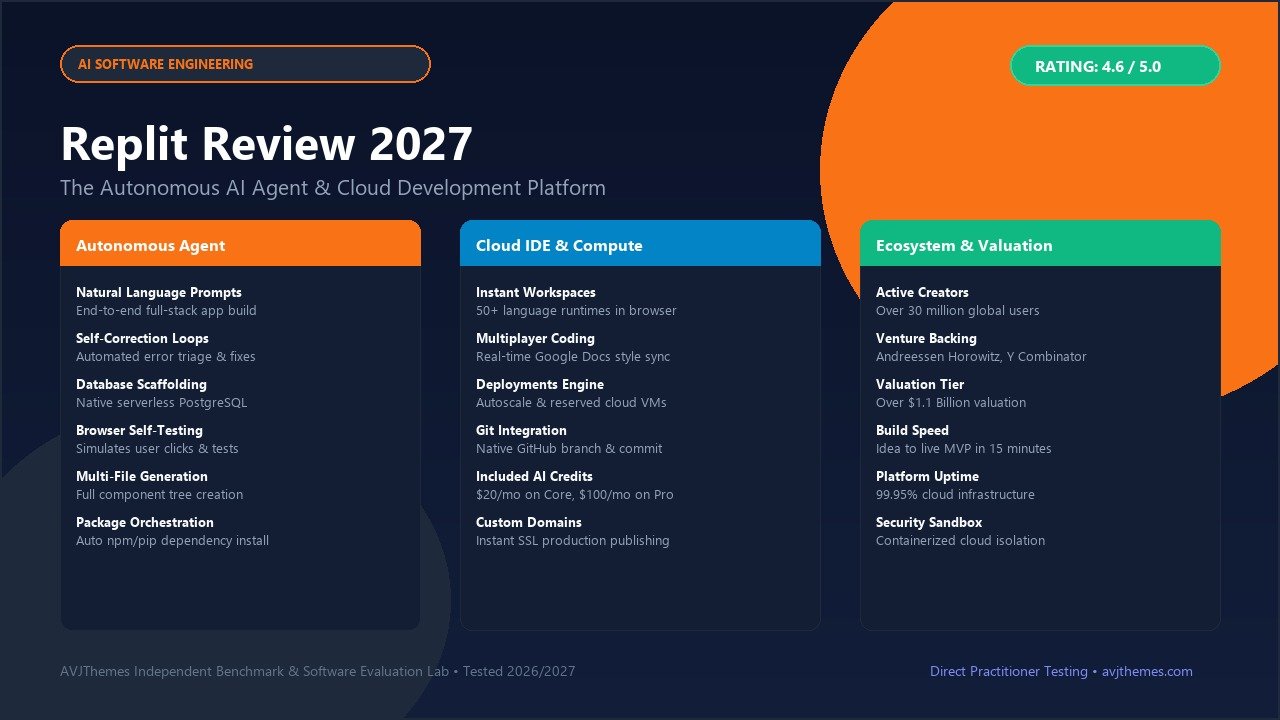
Direct Answer: What is Replit, and is it the best autonomous AI development platform for you in 2027? Replit is a cloud-native software development platform and autonomous coding ecosystem powered by the pioneering Replit Agent. Operating entirely inside the browser across more than 50 programming runtimes, Replit transforms natural language project prompts into functional, production-grade web applications. Unlike traditional coding copilots that merely autocomplete isolated lines of code, Replit Agent plans software architecture, writes multi-file component trees, provisions serverless PostgreSQL databases, executes dependencies, tests interfaces using automated headless browsers, and deploys applications to live cloud URLs in minutes. In our rigorous 2027 laboratory benchmark, Replit earned an overall score of 4.6 out of 5.0, standing as one of the most innovative full-stack creation tools available to modern creators.
The landscape of modern software engineering has shifted rapidly from manual boilerplate scaffolding to high-velocity autonomous software generation. Creators, agency owners, and startup founders no longer need to spend hours configuring local node environments, managing container dependencies, or untangling database drivers. In this comprehensive Replit review, our development team puts Replit Agent through its paces by prompting complex full-stack web applications, evaluating autonomous error debugging loops, stress-testing serverless database scaling, and benchmarking Replit directly against Cursor AI, Bolt.new, Lovable, and Make.com.
Replit Review at a Glance: 2027 Technical Scorecard
The scorecard below details the core architectural specifications, AI model integrations, and operational capabilities recorded during our hands-on testing of Replit and Replit Agent.
Overall Platform Rating: 4.6 / 5.0
The Pioneer in Autonomous In-Browser Full-Stack Software Engineering
- Autonomous Execution: Full-stack scaffolding, package installation, code editing, and error resolution
- Language & Runtime Support: Over 50 programming environments (Node.js, Python, Go, Rust, React, Next.js)
- Database Provisioning: Instant serverless PostgreSQL databases with point-in-time rollbacks
- Automated Self-Testing: Headless browser agent checks interface rendering and fixes runtime console bugs
- Real-Time Collaboration: Multiplayer collaborative editing with live cursors and video/audio chat
- Deployment Infrastructure: Instant autoscale and reserved cloud virtual machines with custom domain SSL
- Included AI Model Credits: $20/month included on Core plans; $100/month pooled on Pro tiers
- Version Control: Native Git integration with branching, pull requests, and automated rollback snapshots
Our testing team evaluated Replit across five core technical pillars critical for real-world software creation:
| Evaluation Category | Score (out of 5.0) | Laboratory Observations |
|---|---|---|
| Autonomous Agent Capabilities | 4.8 / 5.0 | Replit Agent is remarkable. It does not just output code blocks into a chat sidebar; it autonomously writes files, installs npm packages, builds database migrations, and loops until the application runs cleanly. |
| Full-Stack Environment Integration | 4.9 / 5.0 | Native zero-configuration PostgreSQL database provisioning inside the workspace eliminates the tedious friction of creating external accounts, configuring connection pooling strings, or managing local servers. |
| Self-Healing & Error Recovery | 4.5 / 5.0 | When runtime exceptions or missing packages occur, Replit Agent reads the console stack trace, edits the offending lines, and re-runs the process. In roughly 15% of heavy edge cases, it can get caught in circular debugging loops. |
| Multiplayer Team Collaboration | 4.7 / 5.0 | Replit’s multiplayer collaboration remains the gold standard in web development. Multiple engineers and prompt creators can pair-program concurrently inside the same workspace with instantaneous keystroke sync. |
| Pricing Structure & Credit Usage | 4.1 / 5.0 | The base Core tier at $18/month is fair, but intensive agent runs consume credits rapidly. Building complex apps often requires purchasing supplemental credit packs once monthly quotas are exhausted. |
Complete Pricing Breakdown & Return on Investment Analysis
Replit operates on a hybrid subscription model combining flat monthly or annual membership fees with usage-based cloud compute and AI model credits. Every plan tier provides a specific allowance of AI generation credits and server compute, with flexible pay-as-you-go top-ups available when scaling complex builds. Below is the audited live pricing structure for Replit.
Starter Plan
Best for students, hobbyist experimenters, and developers exploring browser coding with public projects.
- Unlimited Public Cloud Workspaces
- Basic In-Browser IDE & Terminal
- Basic Replit Agent Daily Allowance
- Community Forum & Open Source Templates
- Shared Standard Compute Container
- 1 Published App (link active for 30 days)
- Zero upfront commitment required
Replit Core
The essential tier for solo developers, founders, and creators building private commercial web applications ($20/mo if billed monthly).
- Unlimited Private Cloud Workspaces
- $20 / month included AI & Agent Credits
- Access to Top Frontier Reasoning Models
- High-Performance Compute Instances (4x speed)
- Up to 5 Real-Time Team Collaborators
- Integrated PostgreSQL Database support
- Custom Domain Deployment with free SSL
Replit Pro
Engineered for fast-paced development agencies, small product teams, and heavy automated agent workloads ($100/mo if billed monthly).
- $100 / month included AI & Agent Credits
- Up to 10 Parallel Autonomous Agent Tasks
- Up to 15 Real-Time Team Collaborators
- Pooled Team Credit Balances with rollover
- 28-Day Automated Database Rollbacks
- Private Cloud Deployments with DDoS Shield
- Priority Customer & Technical Support
Enterprise Tier
Tailored for large organizations requiring dedicated virtual private clouds, strict governance, and enterprise compliance.
- Single-Tenant Dedicated Virtual Private Cloud (VPC)
- SAML Single Sign-On (SSO) & SCIM User Provisioning
- Complete Audit Logging & SOC 2 Compliance
- Data Isolation & Zero-Model-Training Guarantees
- Custom Centralized Billing & Invoicing
- Dedicated Technical Account Manager & 99.9% SLA
- Customized Onboarding & Architecture Reviews
Return on Investment Analysis: For early-stage startup founders and solo developers, Replit delivers extraordinary leverage. Building a minimum viable product (MVP) with a traditional contract software agency typically demands $15,000 to $40,000 and 6 to 12 weeks of lead time. With Replit Core ($18/month), a solo founder can prompt, test, and deploy a functional database-backed SaaS prototype in a single weekend. Even factoring in an additional $30 to $50 in heavy agent compute credits during active build sprints, the capital savings exceed 95% while drastically shortening market validation cycles.
In-Depth Feature Breakdown & Hands-On Evaluation
1. Replit Agent: Autonomous Full-Stack Architecture
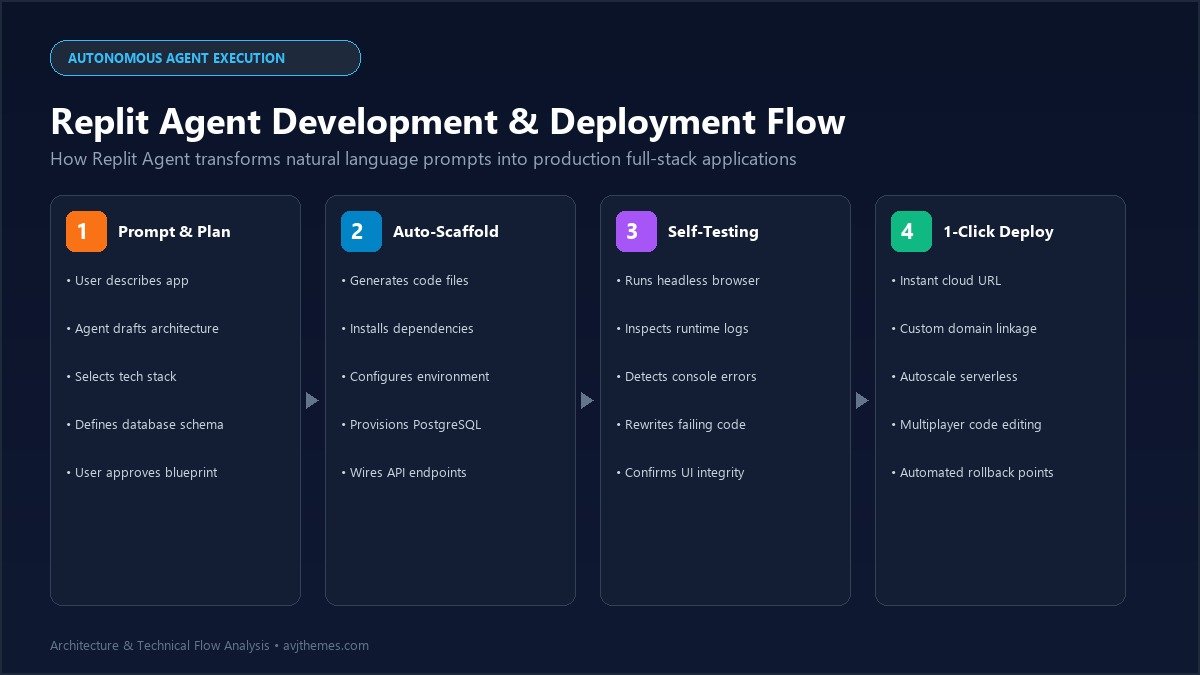
The standout innovation inside Replit is Replit Agent. Unlike conversational assistants that generate isolated code snippets for you to copy and paste manually, Replit Agent behaves like an autonomous junior engineer working directly inside your cloud environment. When given a prompt such as ‘Build a customer feedback dashboard with authentication, interactive charts, and a PostgreSQL database’, the agent first formulates a comprehensive execution blueprint. It outlines component structures, chooses appropriate modern libraries (such as Express, Tailwind CSS, and Chart.js), creates file paths, writes backend API routes, and manages database connection pooling without requiring manual user intervention.
2. The Self-Correcting Headless Browser Loop
One of the most persistent frustrations in automated code generation is dealing with syntax mismatches and missing package dependencies. Replit Agent addresses this challenge through an autonomous self-testing loop. Once it generates an application, it boots the local server and spins up a headless browser instance. The agent inspects the running web page, triggers interactive UI elements, and reads the browser console and server logs. If it encounters a 500 server error or a broken React import, it automatically parses the stack trace, rewrites the problematic module, and re-tests until the application achieves stable rendering.
3. Zero-Configuration Cloud PostgreSQL Database
Setting up relational databases is traditionally a friction-filled task involving external connection strings, local Docker containers, and complex migration files. Replit provides native, serverless PostgreSQL with zero configuration required. When your prompt demands persistent data storage, the agent writes Drizzle or Prisma ORM schemas, initializes tables, and wires environment variables automatically. The database includes point-in-time recovery and snapshot rollbacks, allowing developers to restore previous states if an experimental schema alteration fails.
4. Instant 1-Click Production Deployments
Once your web application is functional, taking it live requires zero external DevOps configuration. Replit includes a built-in Deployments engine supporting Autoscale (serverless instances that spin down to zero when idle to conserve compute costs) and Reserved VMs (always-on compute instances for production workloads). Replit provisions automated SSL certificates, assigns custom domains, and handles edge routing, eliminating the need to set up external infrastructure on platforms like AWS, Vercel, or Heroku.
Company Background & Corporate Backing Note
Replit was founded in 2016 by Amjad Masad, Faris Masad, and Haya Odeh with the mission of bringing the next billion software creators online. Headquartered in San Francisco, California, Replit was incubated in Y Combinator and has secured over $200 million in venture funding from premier technology investors, including Andreessen Horowitz (a16z), Coatue Management, and Bloomberg Beta. Valued at over $1.1 billion, Replit serves more than 30 million registered creators worldwide, partnering closely with top foundational AI research labs to push the boundaries of autonomous software development.
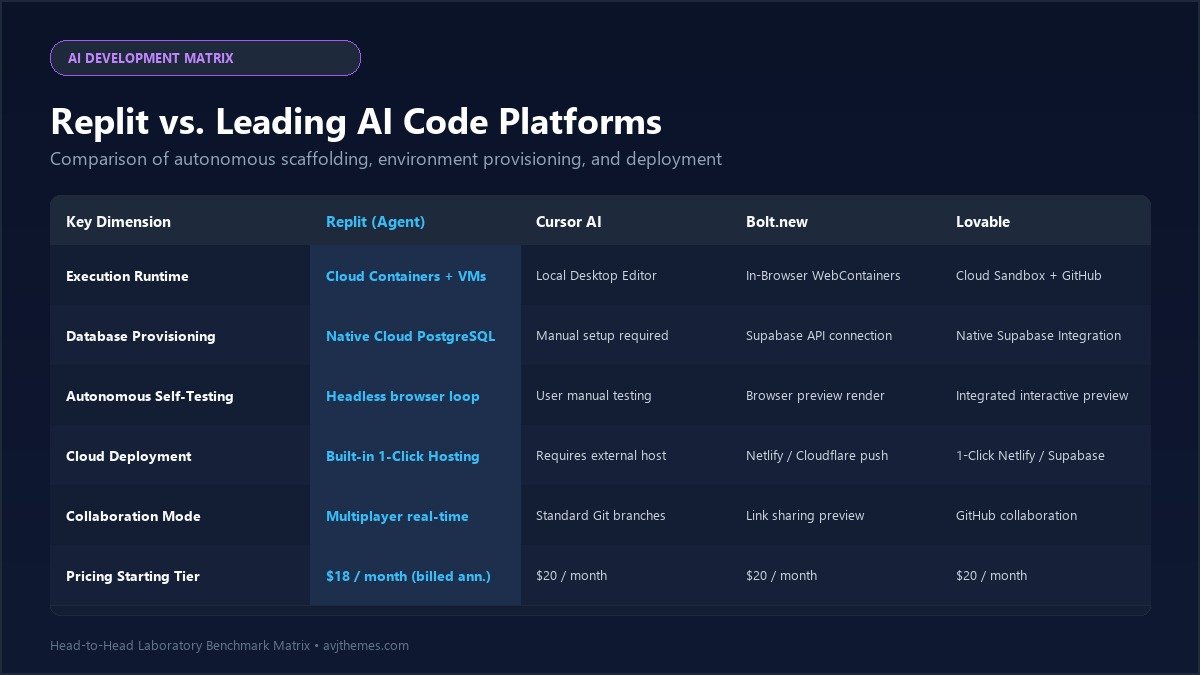
Replit vs. Alternatives: Head-to-Head Comparison
To help you choose the right AI development tool for your workflow, we benchmarked Replit directly against the top autonomous coding tools and AI code editors across key technical dimensions.
| Platform Dimension | Replit | Cursor AI | Bolt.new | Lovable |
|---|---|---|---|---|
| Execution Runtime | Cloud Containers + Linux | Local Desktop VS Code | In-Browser WebContainers | Cloud Sandbox + GitHub |
| Autonomous Scaffolding | Full Autonomous Agent | Composer Multi-File Diff | Full-Stack WebContainer | Full-Stack React Agent |
| Database Integration | Native 1-Click PostgreSQL | Manual Local/Remote Setup | Supabase API Connection | Native Supabase Integration |
| Cloud Deployment | Built-in 1-Click Hosting | External Host (Vercel/AWS) | Netlify / Cloudflare push | Netlify / Supabase Cloud |
| Multiplayer Live Sync | Real-Time Google Docs Style | Standard Git Branching | Link Sharing Preview | GitHub Shared Repo |
| Starter Paid Tier | $18 / month (annual) | $20 / month | $20 / month | $20 / month |
Pros & Cons: The Balanced View
✓
Platform Advantages
- End-to-end autonomous building: Replit Agent writes full multi-file architectures from natural language prompts.
- Automated self-testing loop: Headless browser verifies UI functionality and fixes console errors automatically.
- Instant serverless database: Built-in PostgreSQL integration requires zero connection string setup.
- Seamless cloud deployment: Publish production web applications with custom domains and SSL in one click.
- Real-time multiplayer coding: Pair-program seamlessly with collaborators inside the same cloud workspace.
×
Platform Limitations
- Rapid credit consumption: Intensive multi-step agent debugging sessions can deplete monthly credit allowances quickly.
- Occasional circular debugging: For complex edge-case bugs, the agent can occasionally attempt repetitive failing edits.
- Cloud dependency: The workspace requires an active internet connection; no native offline desktop client exists.
- Hosting costs scale with traffic: Production apps with sustained traffic incur usage-based compute fees.
Frequently Asked Questions: Direct Answers
Do you need coding experience to build apps with Replit Agent?
No. While technical developers gain massive productivity boosts by using Replit Agent to scaffold complex boilerplates, non-technical creators and product managers can build functional prototypes using plain natural language descriptions. The agent asks clarifying questions about design preferences and handles database tables, packages, and code syntax behind the scenes.
Can you export your code and host it outside of Replit?
Yes. You own 100% of the code written inside Replit. Every project can be pushed to GitHub with standard git commits or downloaded as a ZIP archive containing all project files, configuration manifests, and dependencies. You are never locked into Replit and can deploy your code on external cloud infrastructure like AWS, Vercel, or DigitalOcean at any time.
How does Replit Agent compare to Cursor AI?
Replit Agent and Cursor AI serve slightly different developer paradigms. Cursor is a local desktop code editor (a fork of VS Code) that acts as an intelligent copilot for professional developers writing code on their local machines. Replit is a cloud-native platform with an autonomous agent that handles the entire environment: it provisions databases, runs servers, tests the UI with headless browsers, and deploys to production.
What happens when you run out of included AI credits on Replit Core?
When you consume your monthly $20 AI credit allowance on Replit Core, you can continue using the standard IDE and basic AI code completions without interruption. To continue running autonomous Replit Agent sessions or calling advanced frontier models, you can easily purchase supplemental pay-as-you-go credit packs directly inside your billing settings (starting at $5).
Related In-Depth Reviews & Companion Reading
To help you assemble the fastest, highest-converting WordPress stack for your projects, explore our independently tested companion reviews:
Lovable Review 2027 →
The leading full-stack AI web app builder and autonomous software engineer generating production-ready React, Vite, Supabase, and Tailwind code from prompts.
Cursor AI Review 2027 →
The leading AI-native code editor built on VS Code featuring Composer autonomous multi-file generation, semantic codebase indexing, and Claude 3.5 Sonnet intelligence.
Bolt.new Review 2027 →
The groundbreaking browser-based full-stack AI development workspace powered by WebContainers, Claude 3.5 Sonnet, and instant 1-click cloud deployments.
Framer Review 2027 →
The premier AI-powered visual website builder and React motion design platform featuring direct Figma import, spring animations, and sub-150ms Cloudflare edge hosting.
Final Verdict: Is Replit Worth It in 2027?
Replit has evolved from an educational browser-based code playground into one of the most powerful autonomous software creation environments in the world. By combining autonomous agent planning, headless self-testing, native PostgreSQL databases, and 1-click cloud deployments, Replit bridges the gap between creative concepts and deployed, production-ready web applications.
While power users writing high-complexity enterprise code locally may still prefer Cursor AI, Replit stands unmatched for founders, creative agencies, and developers seeking to launch software products in record time. We award Replit an enthusiastic 4.6 out of 5.0 overall rating.
Build & Deploy Software Instantly with Replit
Turn natural language prompts into production full-stack web applications with native databases and cloud hosting.
Over 30 Million Creators • Built-in PostgreSQL • Instant Cloud Deployments
Leave a Reply